As part of the “Data Journalism for Climate Education” project, educational activities focused on renewable energy sources (RES) were carried out. During the lessons, students worked using active learning methods, combining discussion, video materials, experiments, and hands-on technical tasks.
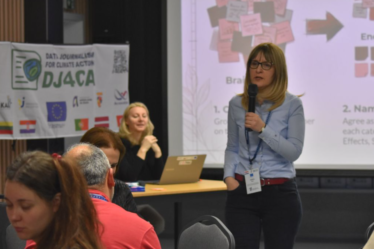
At the beginning of the session, students collaboratively created a mind map to assess and organize their existing knowledge about different energy sources. During this activity, they listed various types of energy sources and discussed their advantages and disadvantages, paying particular attention to environmental impact, costs, availability, and the stability of energy production.
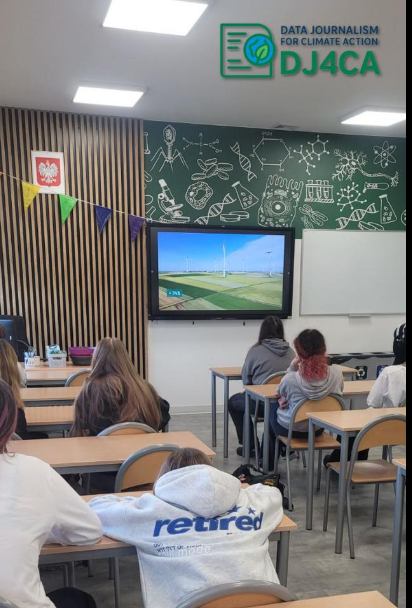
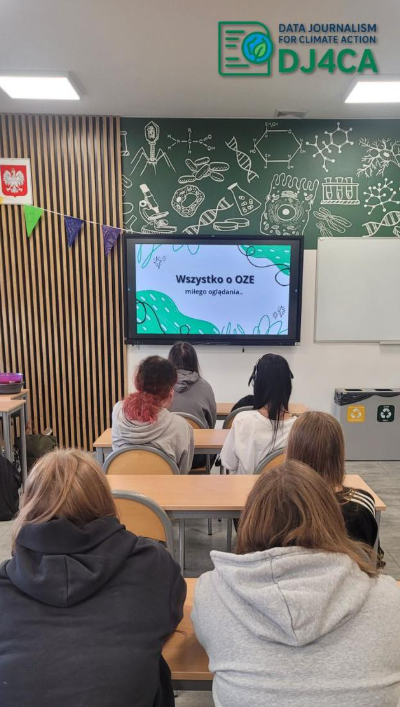
The next stage involved watching a short educational video on renewable energy sources, which served as an introduction to further activities and helped unify the students’ basic understanding of the topic.
This was followed by an experiment that allowed students to practically understand how hydrogen can be produced through the electrolysis of water. Students observed the process and discussed the potential applications of hydrogen as an energy carrier.
At the end of the session, students worked in groups on a construction task. Each group built a model of a wind turbine using recycled materials and simple components such as polystyrene, used plastic spoons, and wooden sticks. This activity enabled students to connect theoretical knowledge about wind energy with practical application, while also developing teamwork skills and creative problem-solving.